
Things to be Aware of
There are a few things that needs to be payed attention to the next time you operate an ethanol fire.
Bioethanol (or any fuel) should not be stored next to or near your fire.
1. If you want to refill it, it is important to wait at least 30 minutes. During this time the fire can cool down.
2. The fireplace should never be filled up when it is burning. It could lead to explosive combustion, which you may not be able to control. Therefore, as with the previous point, you must wait at least half an hour before pouring new ethanol into it.
3. If possible, only use bio-ethanol with a purity level of 96.6%. Failure to do so is unlikely to lead to a dangerous situation, but can still be unpleasant. This means that poor quality fuel or fuel with an incorrect degree of purity can lead to poor oxidation. This, in turn, leads to an unpleasant smell. In addition, it is possible that the flame of the fireplace will often go out because the degree of purity is too low.
4. When lighting your bioethanol fire, it is best to employ long matches or a long stick lighter. Often it ignites very quickly, which may prevent you from getting your fingers pulled away in time, which in turn may lead to slight oxidation. If you use matches to light the fire, it is important not to leave them inside.
If you have any further questions about the correct use of ethanol, we would be very happy to hear from you.
Refilling or Pumping Bio Ethanol Fuel
Burners and fireplaces are available in different designs and sizes. From very large burners with a high capacity to small burners with a lower capacity. Depending on the model, a corresponding amount of ethanol is required. The rule is simple: for a larger one, you need more ethanol than for a small one.
With large fireplaces, the burning liquid usually does not need to be refilled as often. This is due to the fact that they hold a lot and the bioethanol burner is usually not completely empty. Since you do not have to refill it so often, you can certainly refill it manually. To do this, you pour the ethanol directly into the burner.
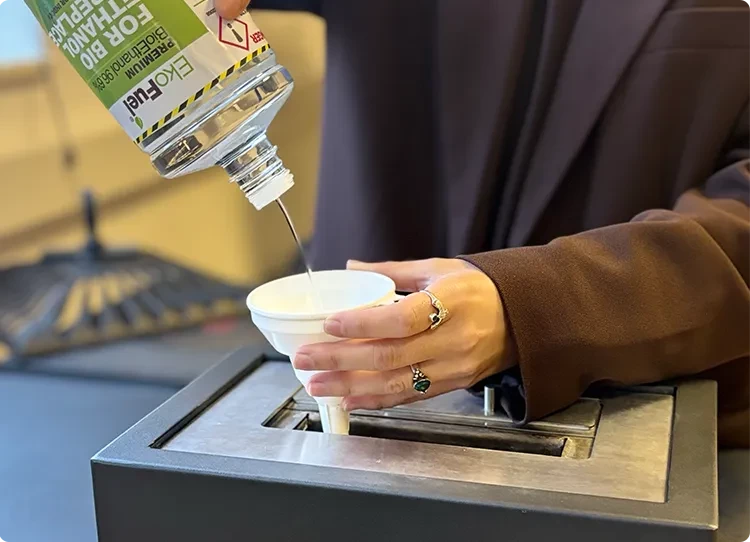
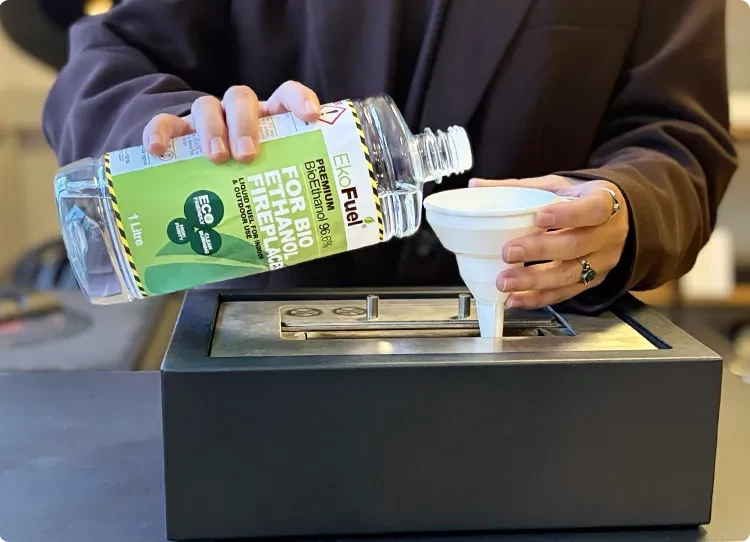
To ensure that nothing goes wrong, it is recommended to use a funnel when pouring. If something should go wrong during pouring, it is important to remove the spill immediately and completely. This is best done with a damp cloth. If the spilled liquid is not removed immediately, this can lead to stains on the floor. If you have any questions regarding the refilling, we will, of course, be happy to help you.
We have also compiled a small collection of useful instructions in which we explain many of the basic things; for example, how to properly fill, light and extinguish an ethanol fireplace.
However, if the ethanol fire is used a lot, you may be looking for something simpler. In our online shop, you can obtain practical ethanol pumps that easily transport the flammable liquid from the canister/bottle to the bioethanol burner. This can be done at the push of a button. One end of the pump goes into the container with the flammable liquid and the other end is put into the ethanol fireplace. In this way, the bioethanol fire is automatically supplied with sufficient bio ethanol fuel.
If it interests you, be sure to check out additional bio fire equipment to view all the useful accessories for bioethanol fireplaces.
How Much Bioethanol Fuel do I Need?
How much you need depends on several factors. Each bioethanol burner is different and so each burner uses a different amount of ethanol. Another factor that is very determined in terms of consumption is the way the fire is used.
A decisive factor in how much is burned is of course how much goes into the burner. Most common fireplaces have a capacity from 0,5 to 5 litres. Of course, there are also fireplaces that are smaller or larger. The calculation is simple. An ethanol fire with a capacity of 5 litres will also burn 5 litres of ethanol when used. So you should be aware that the higher the capacity of the fireplace, the more it usually consumes.
Above a certain size, some bio ethanol fires have a small metal plate made of stainless steel that can be pushed over the opening with a suitable tool. This plate ultimately serves to extinguish the fire. If the plate is pushed over the opening of the fire while it is on, the fire of the biofuel fireplace is smothered and it goes out. A great trick is not to push the stainless steel plate completely over the opening, but only a part of it. This restricts the air supply to the flames and the fire becomes a little smaller. This method allows you to save bio ethanol fuel, because less fuel is burned and fewer litres are used.
It is also important to ensure a good indoor climate. This is achieved by operating your product only in a well-ventilated room.
The combustion of bioethanol is a chemical process. One of the chemical end products that are produced during this combustion is CO2. CO2 is produced during the oxidation of oxygen and is toxic to humans. However, an ethanol fire can by no means produce so much CO2 that it becomes dangerous to humans.
Although you cannot suffer from CO2 poisoning, it is important to have a supply of fresh air, otherwise, you may get a headache after a long stay in a room with a bio fireplace burning. This is by no means pleasant and of course, wants to be avoided. However, the solution is quite simple and does not require much work. It is usually enough to open a window while the fireplace is burning.